
The Cure
Album Art
2024.06
Houston, TX + Los Angeles, LA
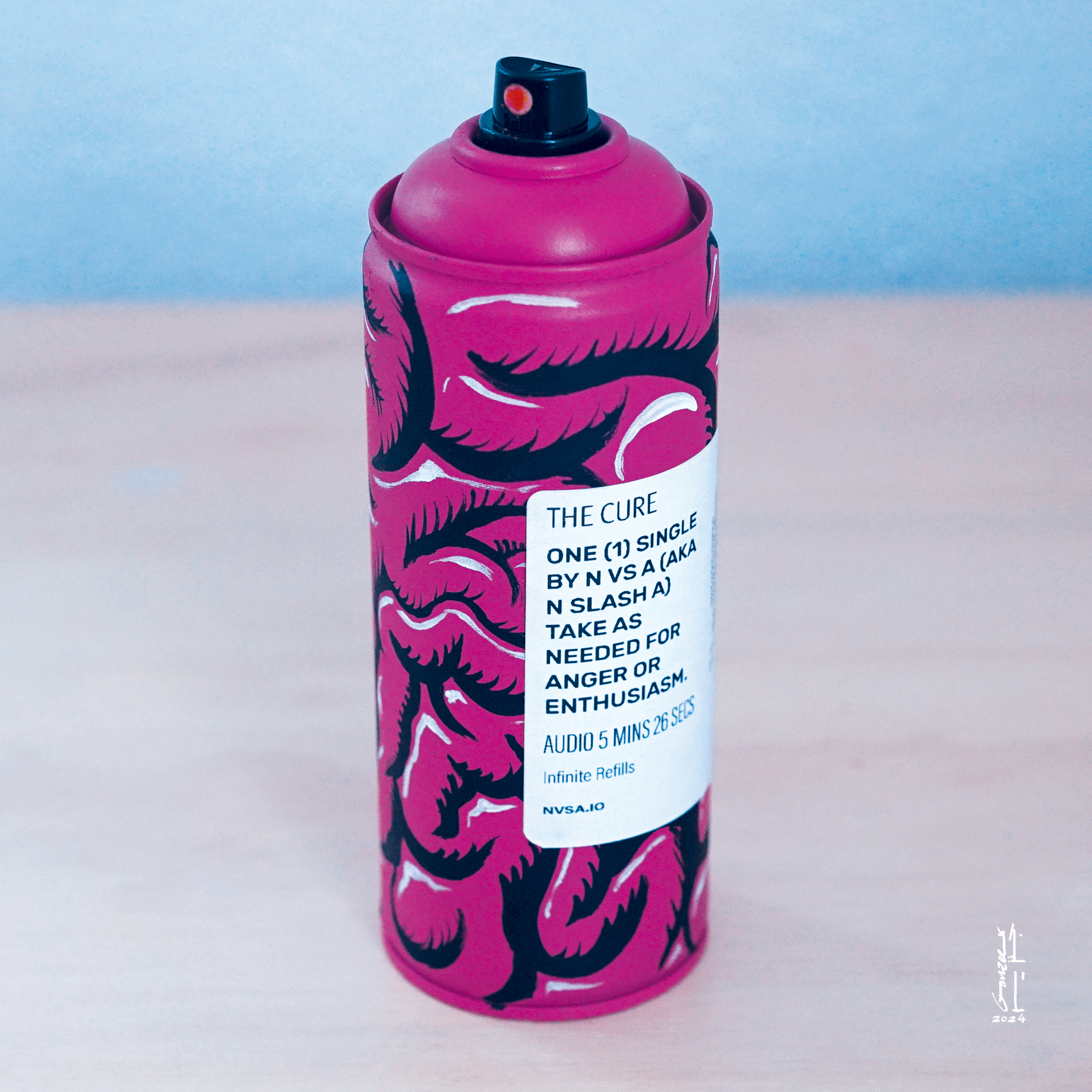
Aerosol and Acrylic Paint on Spraycan + Adobe Illustrator + Printed Sticker + Photography
Created to mark the ten-year anniversary of THE CURE, a single by musician and longtime collaborator N Vs. A (a.k.a. N Slash A), this cover art was commissioned for the song’s re-release and conceived as a visual extension of its themes of protest, urgency, and collective responsibility.
The title alone suggested an entry point rooted in the visual language of medicine and pharmaceuticals—fields associated with treatment, intervention, and the promise of resolution. Rather than approaching this reference literally, the design pairs the clinical with the confrontational, introducing an unexpected element that reflects the song’s political and emotional charge. The lyrics—“The children chanting, what have you done with our tomorrow. We won't listen anymore, we are searching for the cure”—serve as a conceptual foundation, evoking youth-led dissent and a rejection of inherited failures.
This framework led to the aerosol can as a central motif. Widely recognized as a tool of street protest and unsanctioned expression, the aerosol carries connotations of resistance and public objection. At the same time, the object is intentionally complicated. The aerosol alone is an unreliable symbol of meaningful critique, as acts of expression in public space can just as easily be impulsive or empty. To address this ambiguity, the object is transformed through the addition of brain matter enveloping the can.
This intervention reframes the aerosol as a vehicle for considered action rather than raw impulse. The brain functions as both visual provocation and conceptual qualifier, emphasizing thought, awareness, and intention as prerequisites for protest. In this context, the search for a “cure” is not presented as a purely external solution, but as something that must originate in cognition and collective consciousness.
Although the concept could have been rendered illustratively, the final execution favors physical fabrication. A real spray paint can was painted and altered directly, producing a sculptural object rather than a drawn representation. This decision reinforces the work’s material and political grounding, aligning the process with the realities of the object’s cultural use. The finished piece was then photographed, allowing texture, scale, and physical presence to remain central to the image.
The resulting cover art occupies a space between medical iconography, street culture, and social commentary.