
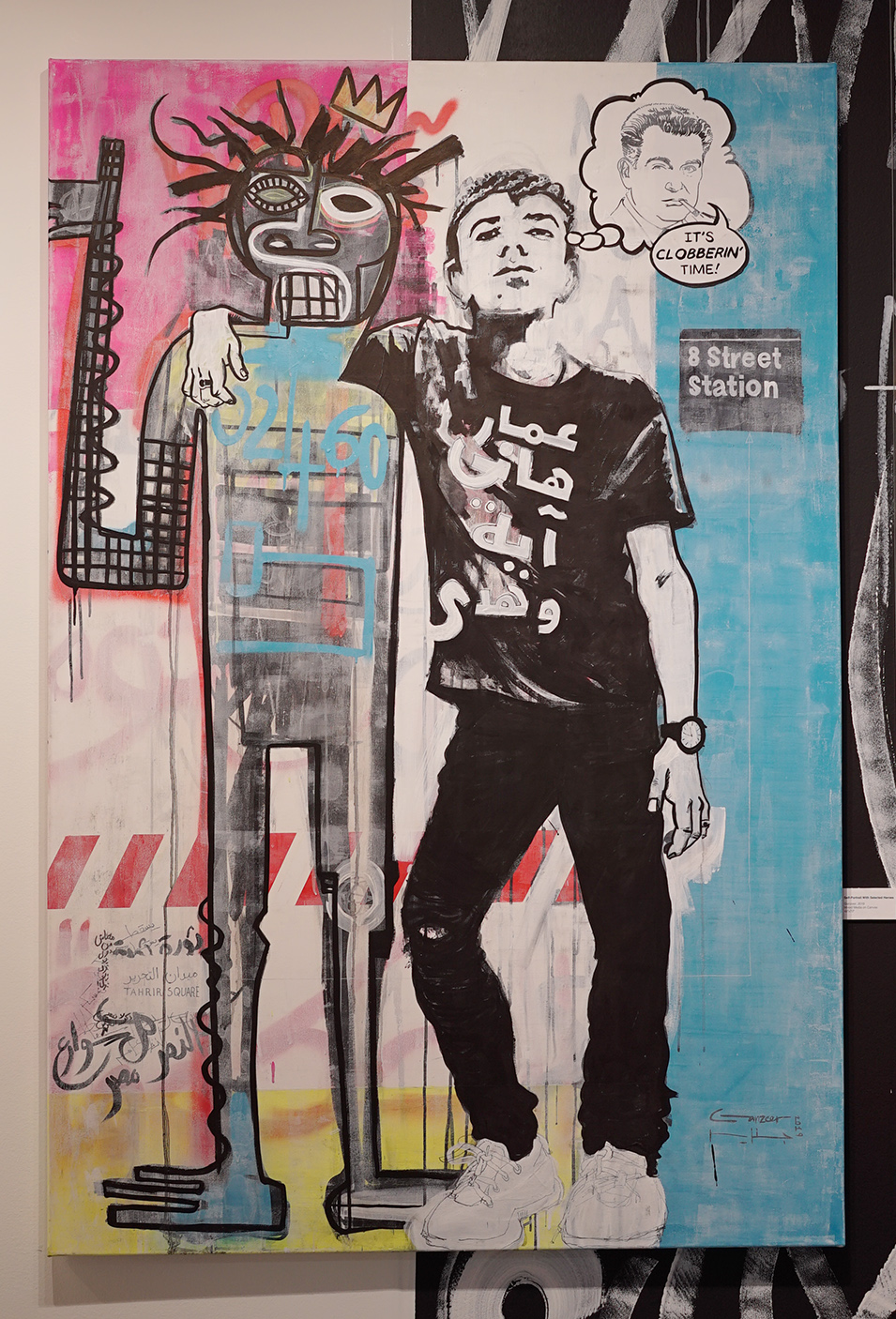
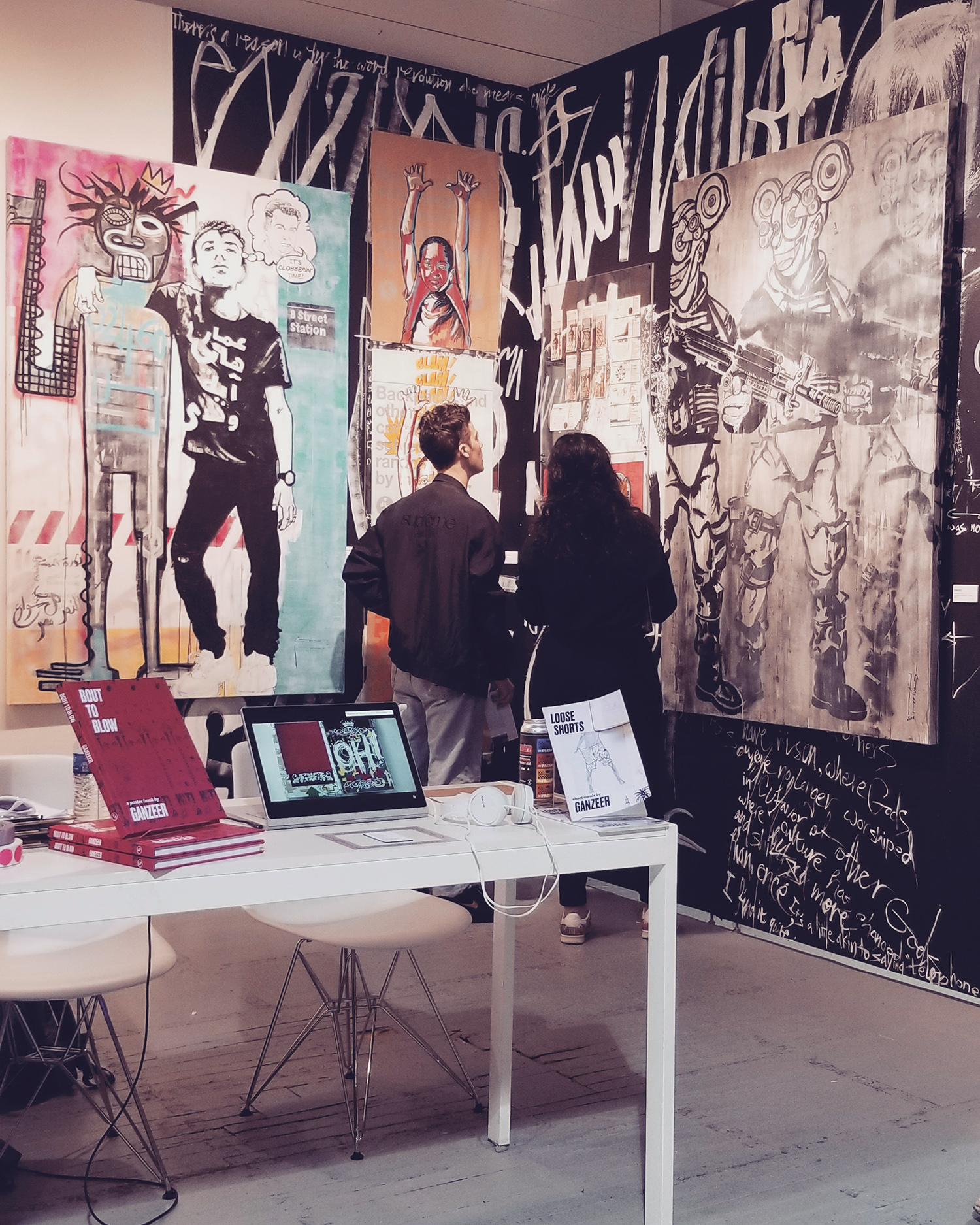
Self-Portrait with Select Heroes
Canvas
2019.05
New York, NY


Mixed Media on Canvas
121.9 x 182.9 cm |
48 x 72
in
This is one of the first paintings I ever made in which I pay direct homage to some of my greatest artistic influences, most prominantly is Jean-Michel Basquiat and king of comics Jack Kirby. On the t-shirt are the names of some of my Egyptian contemporaries, also great influences: Ammar [Abo Bakr], Hany [Rashed], Aya [Tarek], and Huda [Lutfi]. The painting also references my journey from Cairo’s Tahrir Square to New York City’s Greenwich Village.
Exhibitions:
Moniker—New York, 2019
Related Work
Safety First
Canvas
2019.05
New York, NY
Aerosol and Acrylic on Canvas
121.9 x 182.9 cm |
48 x 72
in
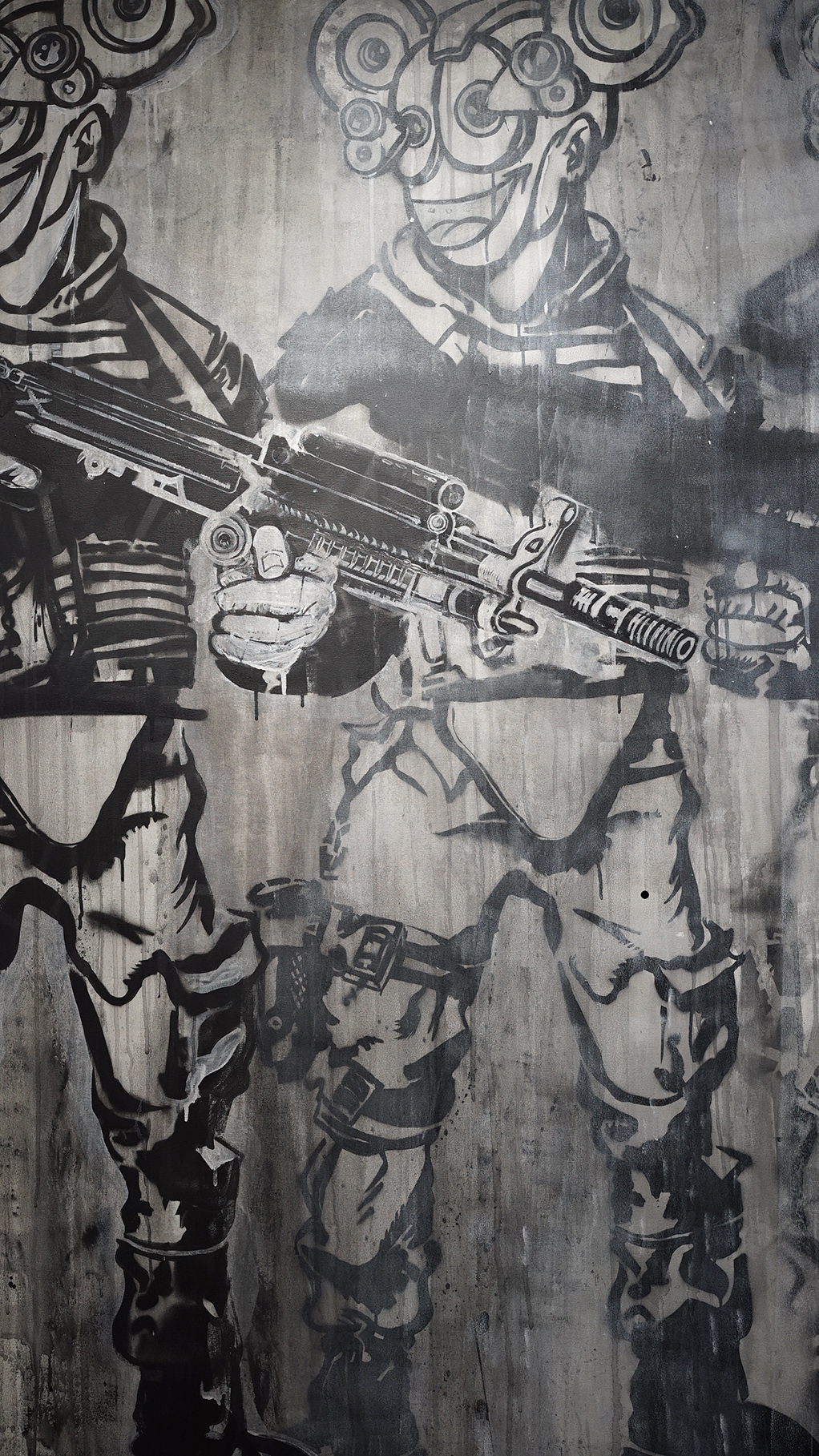
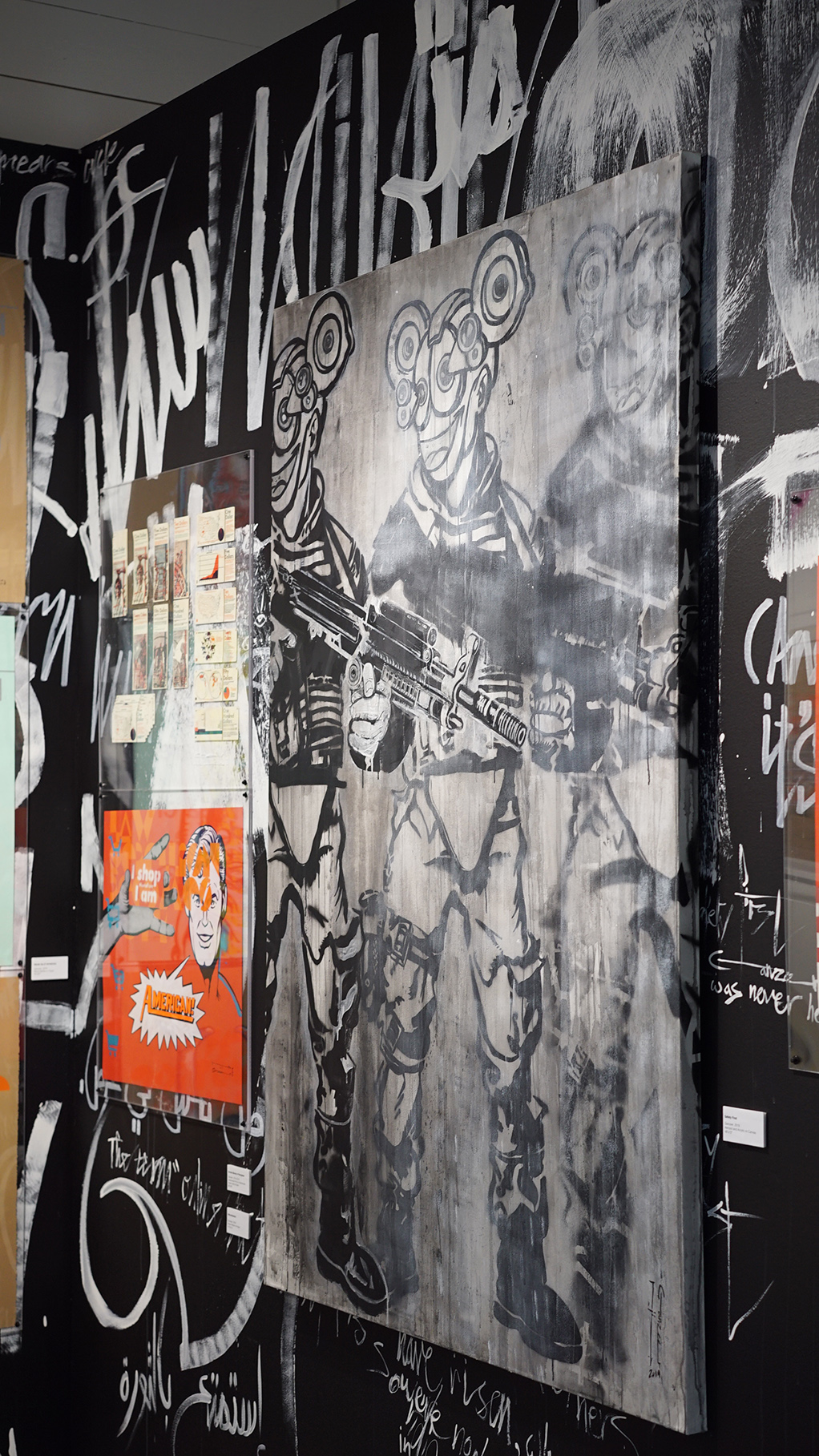
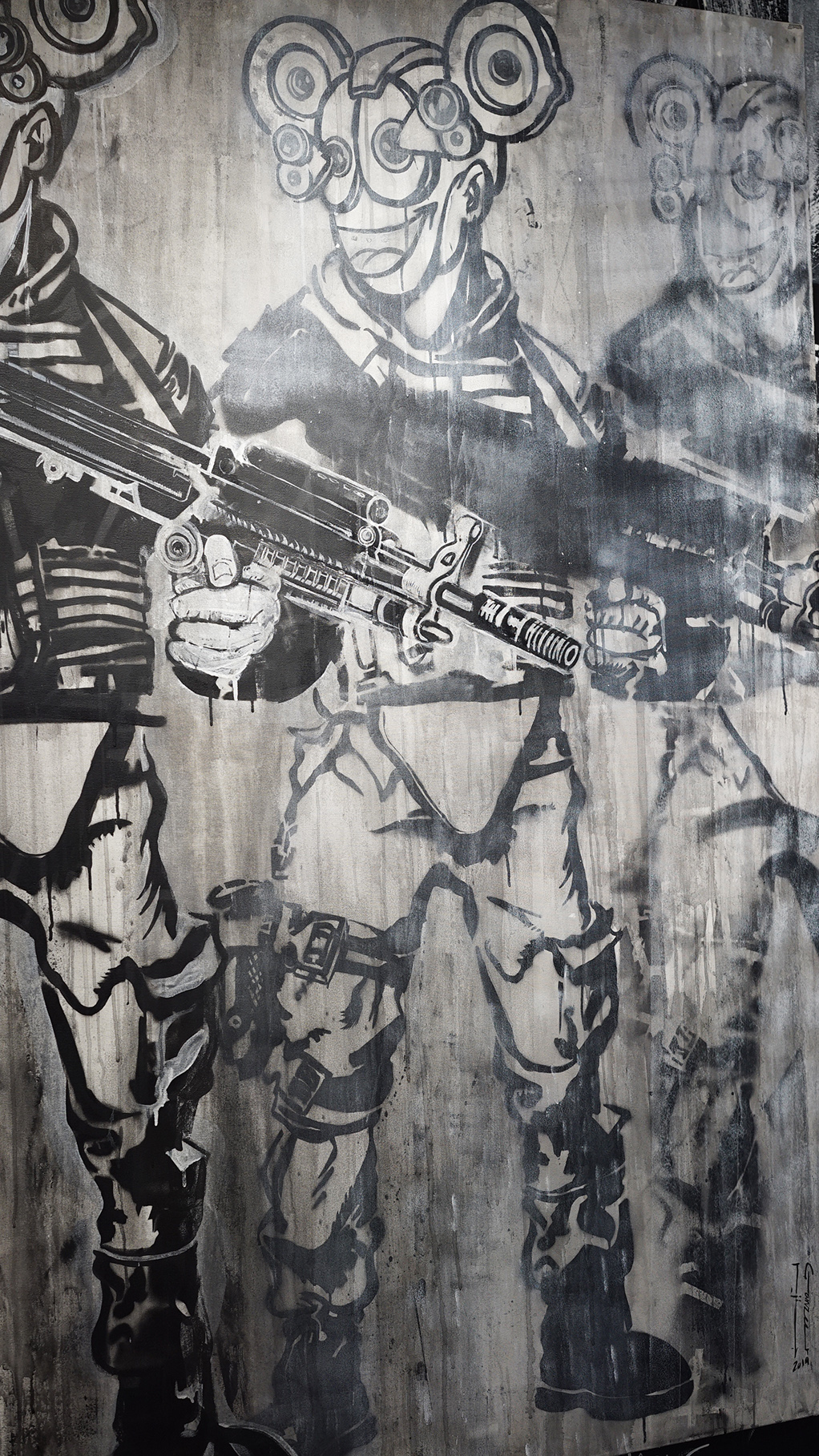
This work functions as a deliberately snarky visual commentary on the security-industrial complex and its ongoing effort to rebrand systems of control, surveillance, and enforcement as friendly, benign, and ultimately beneficial to everyday life. Drawing directly from the visual language and character designs of security personnel featured in my graphic novel The Solar Grid, the piece isolates and exaggerates familiar motifs from that fictional world in order to reflect on their real-world counterparts. What is presented at first glance as approachable and even charming is, upon closer inspection, a carefully constructed facade that masks a far more unsettling infrastructure.
Formally, the work also operates as a quiet homage to Andy Warhol’s Silver Elvis series, borrowing from its seriality, iconic flattening, and cool, reflective detachment. The reference underscores how power, when aestheticized, becomes easier to accept, and how imagery plays a crucial role in normalizing systems that might otherwise provoke discomfort or critique.
Central to the design is the helmet, which is studded with an array of “eyes” and camera lenses. The multiplicity of lenses implies omnidirectional vision and heightened awareness, reinforcing the idea of constant monitoring while simultaneously rendering it visually playful. Surveillance here is not hidden or covert; it is flaunted, stylized, and rendered almost decorative, mirroring how contemporary surveillance technologies are often marketed as smart, efficient, and user-friendly.
Completing the figure is a painted-on smile, borrowed directly from the language of animated cartoons. This exaggerated expression introduces an artificial cheerfulness that clashes with the implications of the helmet’s watchful gaze. The smile functions as a mask—an affect of warmth and friendliness that attempts to soften the underlying reality of control and scrutiny. By juxtaposing cartoonish optimism with overt surveillance cues, the piece highlights the tension between appearance and function, exposing how aesthetics are used to disarm critical awareness. In doing so, the work invites viewers to question not only the imagery itself, but the broader cultural narratives that encourage us to accept ever-expanding systems of security as harmless, protective, and even comforting.
Exhibitions:
Moniker
—New York, 2019
Related Work
Four American Presidents
Canvas
2015—01
New York, NY




Acrylic Paint and Ink on Canvas
36"x36" (approx 91.4 x 91.4 cm) each, or 72” x 72” altogether.
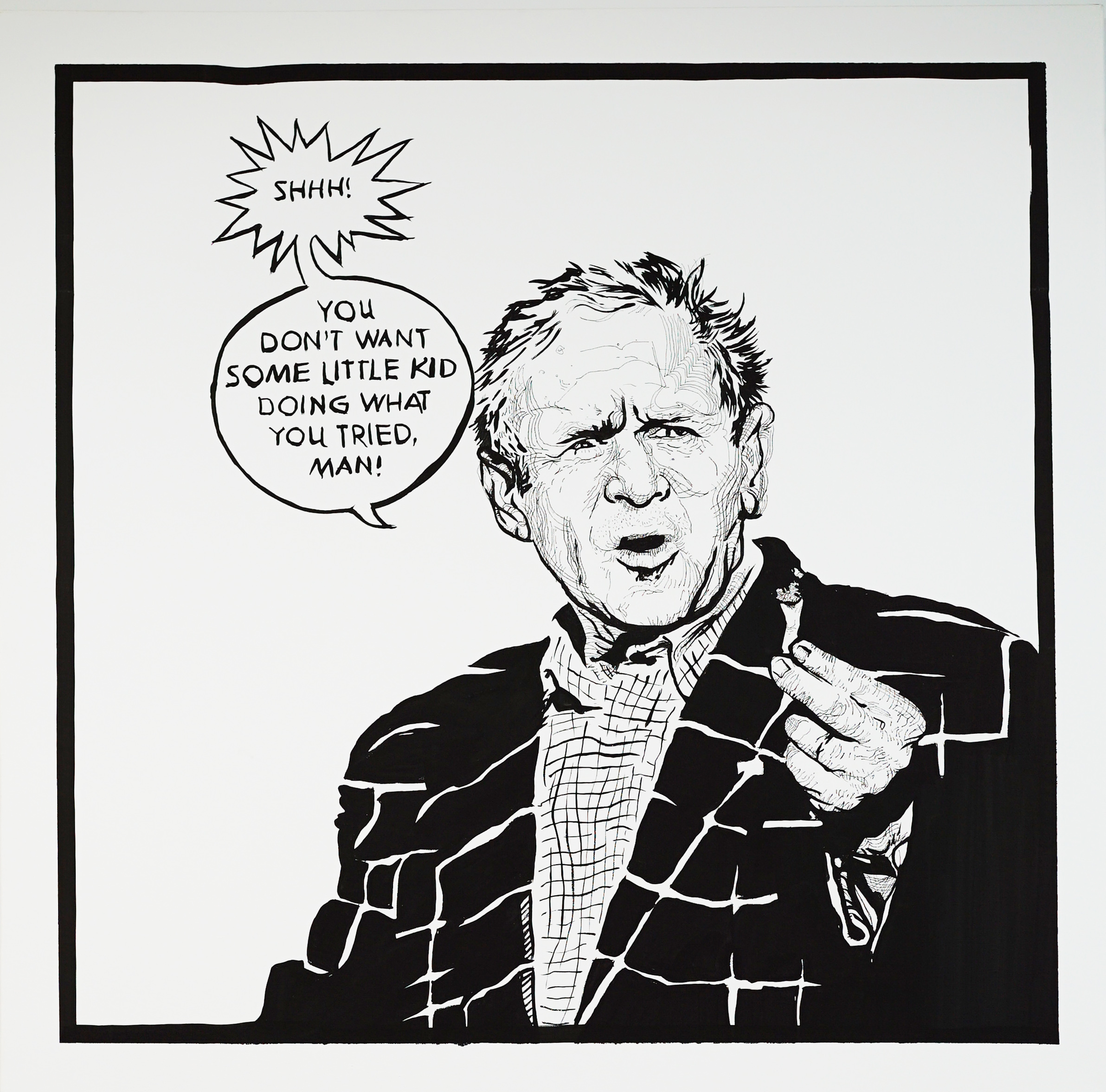
In this four-part series, Four American Presidents, four figures of American political power are brought together in an imagined conversation. Each portrait—rendered in black acrylic and ink on canvas—occupies a separate square measuring approximately 91.4 by 91.4 centimeters. Together, the four panels form a 2x2 grid, recalling both the format of the comic strip and the devotional order of the polyptych. This deliberate structure situates the work at the intersection of popular media and sacred imagery, hinting at the near-religious reverence with which presidential authority is often framed.
The dialogue between these presidents is constructed entirely from actual quotes drawn from their respective public records. Reassembled here, outside of their original historical and political contexts, these utterances take on new and often contradictory meanings. The resulting exchange becomes at once absurd and revelatory—a conversation that exposes the continuity of political rhetoric across time and ideology. What emerges is not so much a debate as an echo chamber, in which the language of leadership circulates endlessly, detached from consequence yet charged with symbolic weight.
Executed entirely in monochrome, the paintings reject the seduction of color in favor of stark contrast and tonal precision. The technique—fine linear hatching reminiscent of engraved printmaking—constructs volume and texture through density of line, producing figures that appear both vivid and spectral. Subtle use of chiaroscuro lends a sense of theatrical illumination, heightening the drama of each encounter. The influence of mass-printed imagery and graphic reproduction is palpable: the presidents appear not as individuals but as icons mediated through photography, print, and television.
This visual language positions Four American Presidents within a long lineage of portraiture as a tool of statecraft and image-making. Yet by appropriating the compositional logic of a comic strip—a form associated with satire, repetition, and mass circulation—the work subverts the solemnity of political representation. The four canvases operate simultaneously as discrete portraits and as narrative panels, their sequence implying continuity, causality, and the illusion of dialogue. The comic form becomes a framework through which the absurdities of power are laid bare.
At its core, the series interrogates how authority is performed, reproduced, and mythologized. The presidents are shown not in moments of decision or crisis, but in casual conversation—smoking, speaking, existing within the ambiguous space between intimacy and spectacle. Their words, though historically documented, become estranged from their original contexts and reanimated as fragments of a shared mythology. Through this reframing, Four American Presidents invites reflection on the performative nature of leadership, the persistence of political narrative, and the uneasy relationship between image, language, and power in the American imagination.
Exhibitions:
All American—New York, 2015
Alwan Art Salon
—New York, 2019
Related Work
Captain King
Canvas
2015.01
New York, NY


Aerosol and Acrylic Paint on Found Oil Painting
“Another standout piece was his depiction of Martin Luther King, Jr. as Captain America. When I asked him why he chose to rebrand famed civil rights leader with a Marvel overlay, he replied with a question: ‘Would you say he is not worthy of being Captain America more than Rogers, whatever his name is? A white blonde guy who took drugs just to get buff?’”
-Animal New York