
Die Neunte Kunst: Unwanted Stories
Installation
2018.01
Oldenburg, DE


Various Media
In early 2018, the Edith-Russ-Haus für Medienkunst in the city of Oldenburg mounted Die Neunte Kunst – Unwanted Stories, an international group exhibition that took the graphic novel as its point of departure. Rather than presenting comics as static artifacts, the curators sought out works that transform the medium’s narrative logic into spatial and sensory encounters—installations, reportage drawings, animations, even the complex narrative structures of video games. The exhibition foregrounded stories that elude photography and conventional documentation: tales of contemporary slavery, reconstructions of Auschwitz, and speculative worlds that thrive in the space between fact, memory, and imagination. The effect was both disorienting and strangely clarifying, as if the simplest of drawn lines could make visible what otherwise resists representation.
It was within this charged context that Ganzeer contributed an installation drawn from his graphic novel The Solar Grid. Critics were quick to seize on its impact. “The Egyptian artist Ganzeer staged hell on earth in the Edith Russ House,” wrote Sabine Komm in Der Tagesspiegel. “In its light installation, our planet is illuminated day and night by artificial satellites—a scenario that has a long lasting effect in the mind of the beholder.”
Ganzeer’s refusal to simply hang pages on the wall was deliberate. Having once exhibited pages of The Solar Grid in Casablanca, he resolved thereafter to withhold further showings until the book’s completion, nervous about the possibility of losing pages in transit—unless, as in this case, an invitation allowed for a radically different approach. Co-director Edit Molnár’s proposition was irresistible: not a showcase of panels, but an opportunity to transform the graphic novel’s world into an experiential installation.
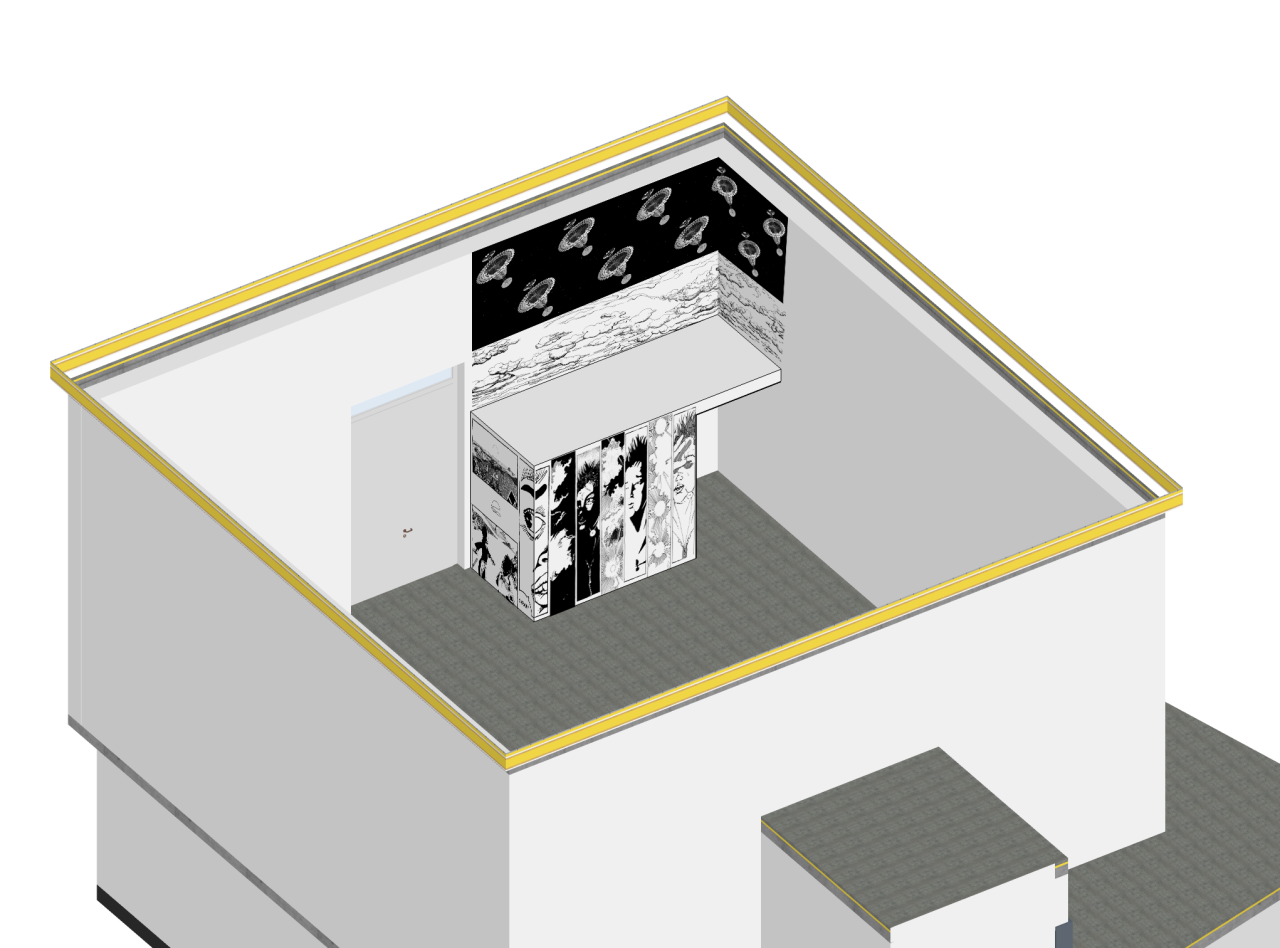
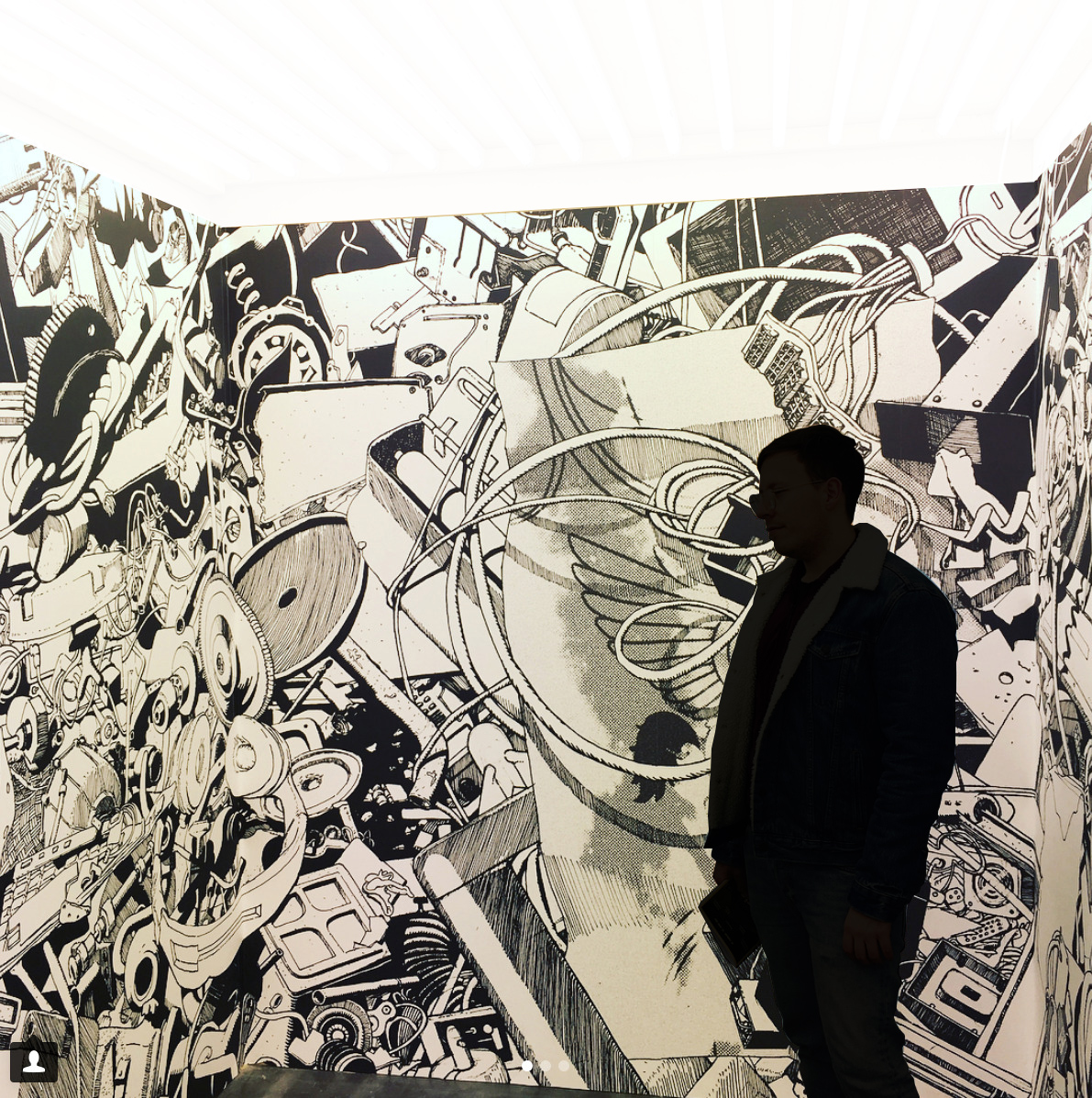
The result was a chamber both immersive and oppressive. Its exterior walls staged a narrative shift: children caught in panic under a setting sun, only to find the sky overwhelmed not by darkness but by an endless proliferation of artificial suns—satellites crowding the heavens. Step inside, and the experience turned visceral. The room was flooded with near-blinding light, its walls covered floor to ceiling with dense illustrations of waste, the very detritus through which the novel’s young protagonists must scavenge to survive. The installation blurred representation and abstraction, offering viewers not so much a scene as a sensation—the claustrophobic disorientation of inhabiting a world oversaturated with refuse and artificial daylight.
At the opposite end of the gallery, three video screens extended this narrative into time-based media.

One screen replayed a trailer originally crafted for The Solar Grid’s Kickstarter campaign. While trailers in museums typically feel like promotional detritus, this one read more like a speculative artifact. Told from the perspective of a protagonist speaking years into the future, it became an uncanny address, its urgency amplified by voice actress Francesca Hogan’s delivery.
On the second screen, what looked like a corrupted transmission flickered into view—an adaptation of a reading performed by Dina Mousawi at the British Library during the 2017 Shubbak Festival. Her voice gave life to Holly Badchapel, a Martian journalist filing reports on Earth’s collapse, the distortion of the signal underscoring the tenuousness of communication across space and time.
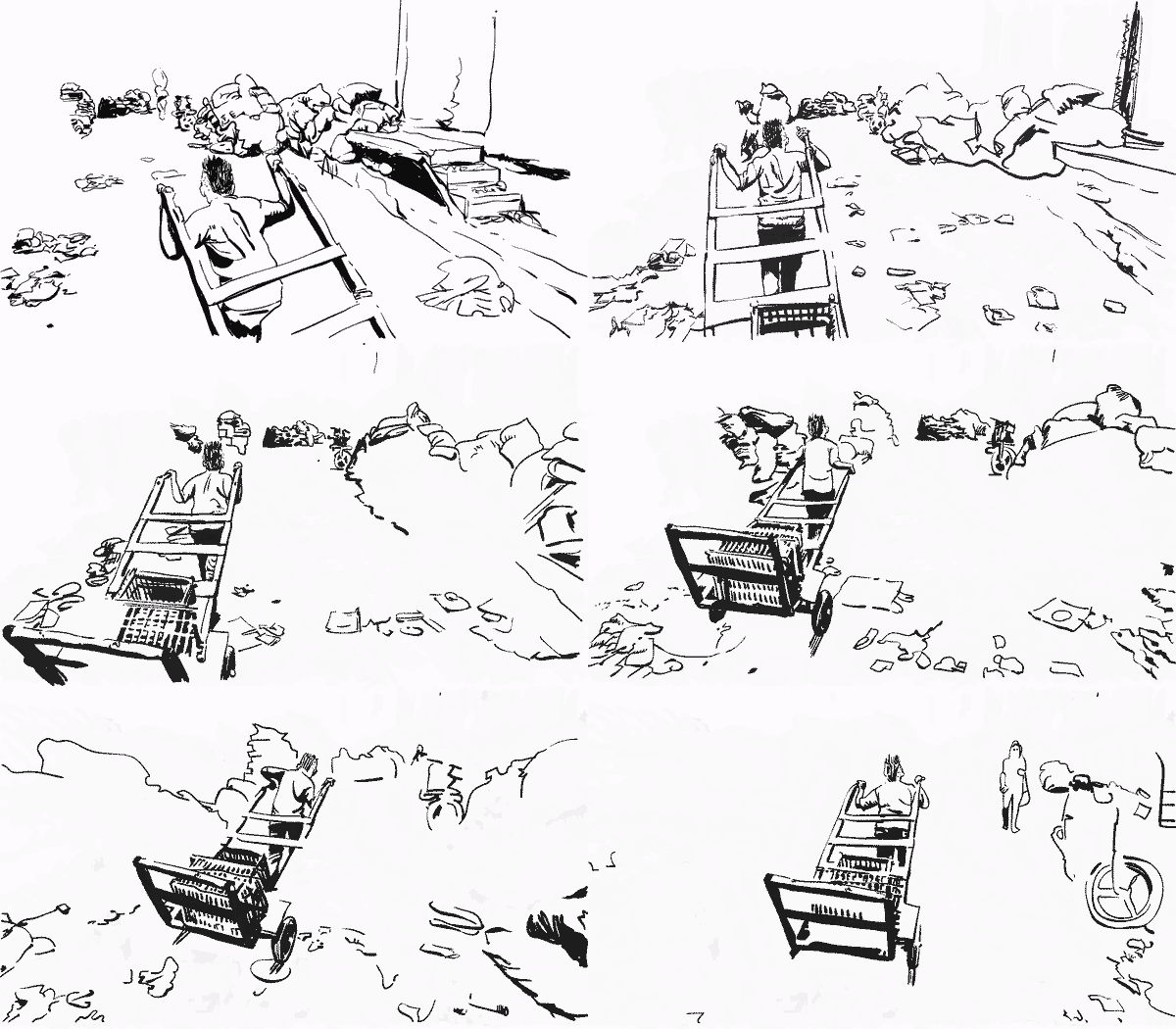
The third screen offered a stark counterpoint: a single, silent looping GIF of Kameen, one of the novel’s protagonists, suspended in the perpetual motion of lugging trash through the novel’s Wastecountry—at once intimate, spectral, and unresolved.
Scattered throughout the space were xeroxed “zine editions” of installments from The Solar Grid, available for visitors to handle and read. These lo-fi, tactile publications grounded the installation in the culture of independent comics, echoing the DIY circulation networks that have long sustained political and experimental work in the medium. Their presence invited pause and engagement, allowing museumgoers to fold themselves into the act of reading even as they were engulfed by light, sound, and image.
Taken together, these elements refused the neat display of finished panels. Instead, they staged The Solar Grid as a living ecosystem—one that bleeds across forms, inhabiting space, sound, and the reader’s hand. In the larger context of Unwanted Stories, Ganzeer’s installation revealed how the graphic novel can operate beyond the page: not merely narrating but engulfing, not only illustrating the future but forcing its confrontation in the present, thereby collapsing the distinctions between sequential art and the immersive strategies of contemporary installation.