
Like Water
Work on Paper
2014.05
New York, NY


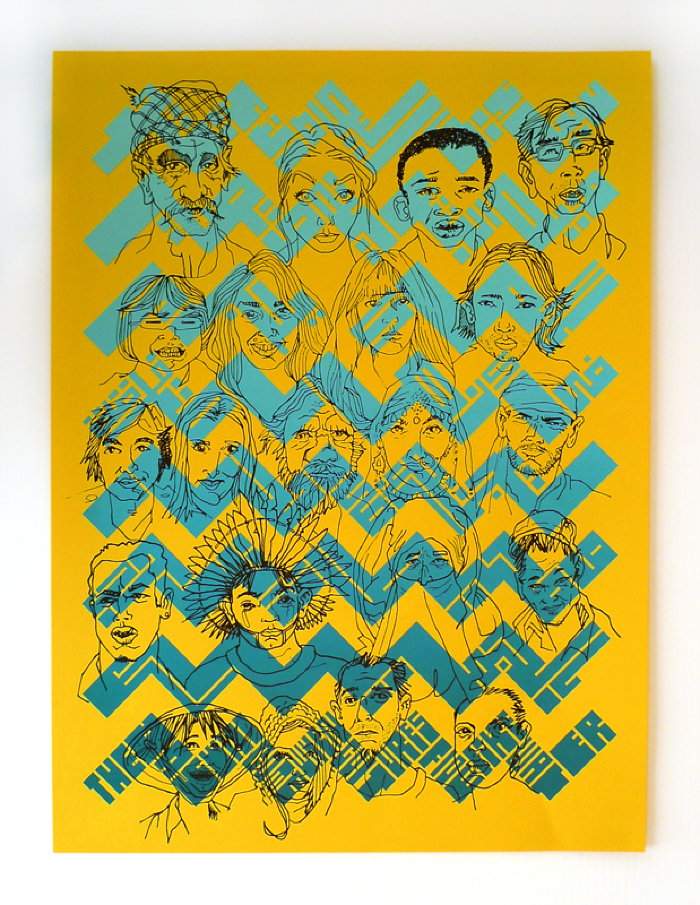



3-Color Screenprint on Paper
48.3 x 63.5 cm | 19 x 25 in
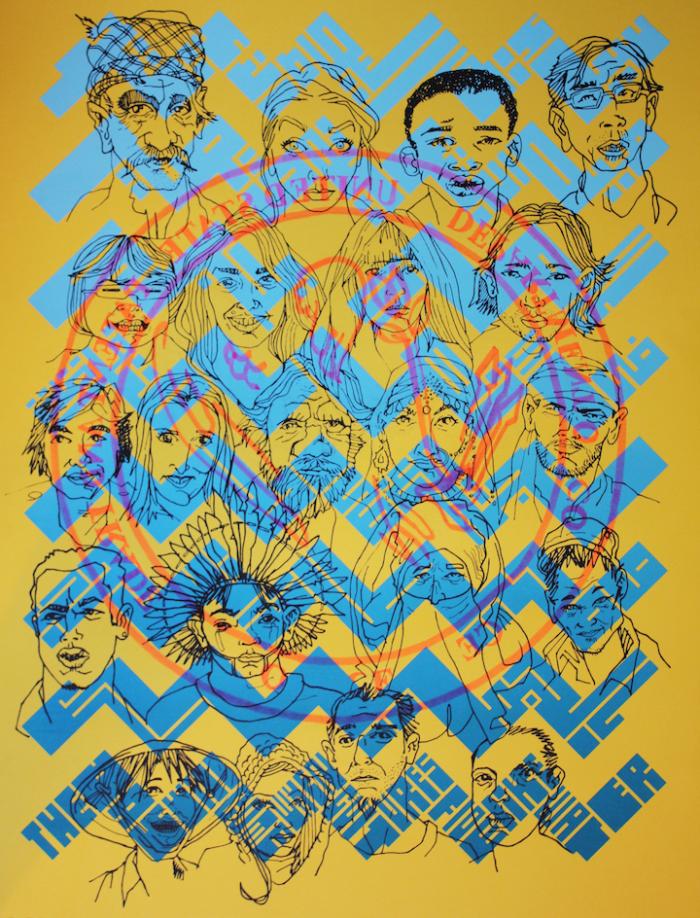
The print is dominated by a fluid, water-like pattern composed entirely of Arabic typography, arranged to evoke currents, ripples, and converging flows informed by the Ancient Egyptian heiroglyph for water. The text forms a poetic statement that roughly translates to: “The day will come when humanity is united and becomes like water, flowing in separate rivers to meet in seas and oceans that welcome everyone.” Rather than functioning solely as readable language, the letterforms operate as visual matter, blurring the line between text and image while reinforcing the metaphor of movement, convergence, and collective belonging. Anchoring the composition at the very bottom is an annotated English translation, presented as a quiet counterpoint to the immersive field of Arabic text above it, and inviting viewers across linguistic backgrounds into the work’s central proposition, underscored by an representational overlay of people from various cultural backgrounds rendered in simple black lineart.
Created shortly after arriving in New York City from Cairo, the piece reflects a moment of geographic and cultural transition, informed by displacement, arrival, and the search for shared ground. The imagery of water—simultaneously separating and connecting—serves as a conceptual bridge between languages, places, and identities. The work positions typography not only as a vehicle for meaning but as a material capable of carrying emotional and political weight, suggesting an aspirational vision of unity that remains grounded in plurality rather than uniformity.
The initial edition was produced as a limited three-color screenprint on white paper, emphasizing clarity and contrast within the layered typographic forms. A subsequent run was printed on yellow paper. Selected prints from this second run were further modified by hand, introducing subtle variants that lend new meaning to each altered piece. Together, the editions explore repetition and difference, reinforcing the work’s broader meditation on collectivity, diversity, and convergence.